Our Vision
We bridge the gap between computational mechanics, mathematical optimization, and artificial intelligence to fundamentally transform how engineered structures and systems are designed.

Research Areas
Research Highlights
Data-driven Inverse Design of Multifunctional Bicontinuous Multiscale Structures
Lili Wang, Jingxuan Feng, Xiaoya Zhai*, Jiacheng Han, Kai Chen, Winston Wai Shing Ma, Ligang Liu, Xiao-Ming Fu
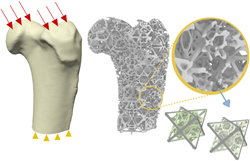
We combine optimization, generative AI, and active learning to construct four L-BOM datasets containing 404,355 boundary-compatible, bicontinuous open-cell microstructures. Their shared boundaries enable rapid multiscale assembly without connectivity post-processing, supporting multifunctional designs with tunable elasticity and permeability, including bone implants and chair components.
Yunkai Zhao+, Lili Wang+, Xiaoya Zhai*, Jiacheng Han, et al.
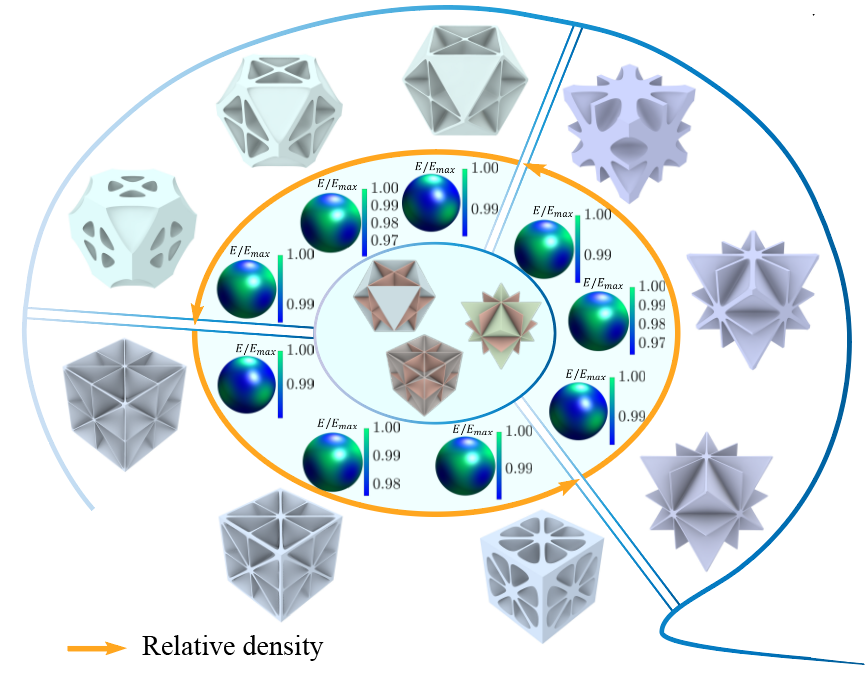
Three near-isotropic, extreme-stiffness, continuous 3D metamaterial sequences are proposed by combining topology optimization and data-driven design, achieving over 98% of the Hashin-Shtrikman upper bounds across densities from 0.2 to 1. Sequences are represented as implicit neural functions for resolution-free continuous density variation.
Topology Optimization of Differentiable Microstructures
2D: Xiaoya Zhai, Weiming Wang, Falai Chen, Jun Wu* | 3D: Jiacheng Han, Xiaoya Zhai*, Lili Wang, et al.
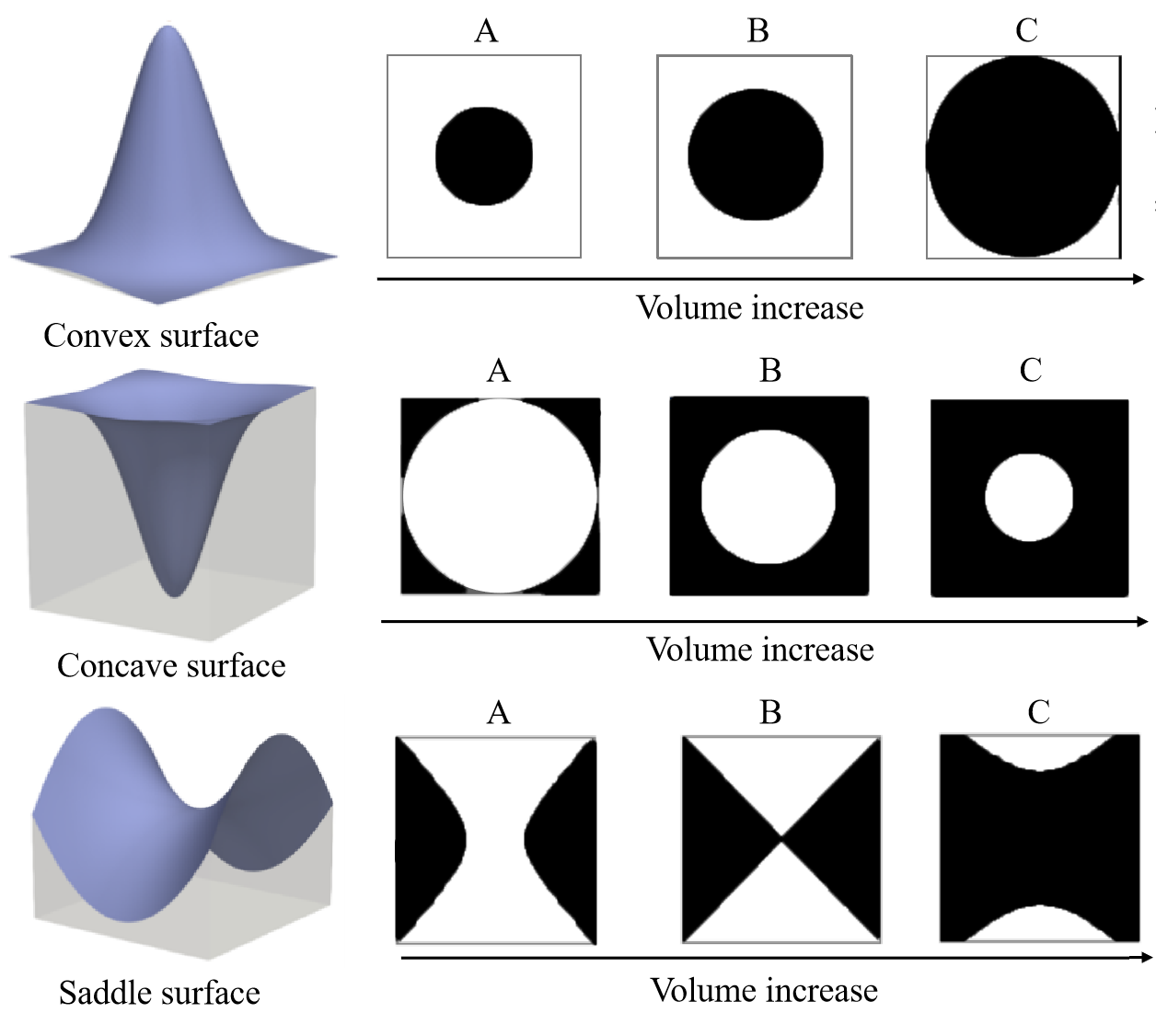
Several 2D/3D differentiable microstructures with bulk modulus close to the Hashin-Shtrikman upper bound are proposed for the first time. Discontinuities are avoided via a novel heat-equation-based regularization, enabling continuously parameterized microstructure families across the full density range.
An Optimized, Easy-to-use, Open-source GPU Solver for Large-scale Inverse Homogenization Problems
Di Zhang, Xiaoya Zhai*, Ligang Liu, Xiao-Ming Fu
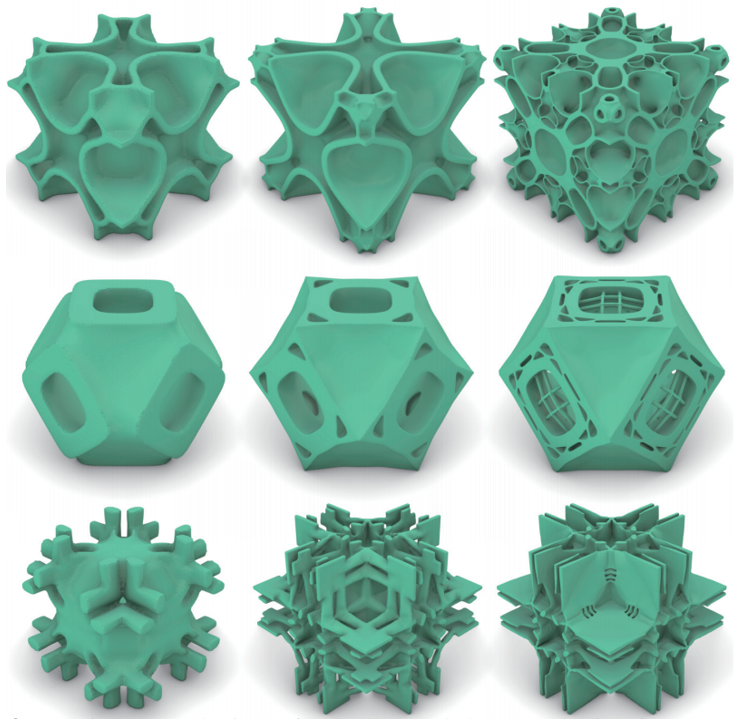
We propose a high-performance GPU solver for inverse homogenization problems to design high-resolution 3D microstructures. Practical examples with 512³ ≈ 134.2 million finite elements run in less than 40 seconds per iteration on an NVIDIA GTX 1080Ti, with an easy-to-use framework requiring fewer than 20 lines of user code.
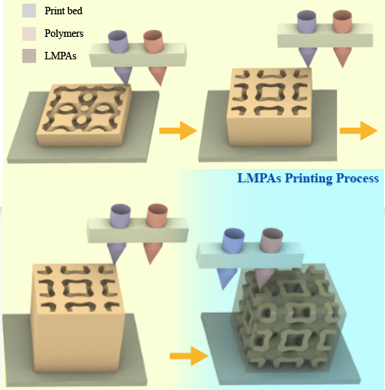
Low-melting-point Alloys Integrated Extrusion Additive Manufacturing
Jingchao Jiang+, Xiaoya Zhai+, Kang Zhang+, et al., Wei-Hsin Liao* (equal contribution)
A novel dual-nozzle extrusion strategy successfully fabricates complex low-melting-point alloy (LMPA) components for the first time, enabling composite parts with improved mechanical properties and integrated circuit manufacturing for smart structures, electromagnetic shielding, and energy harvesting.